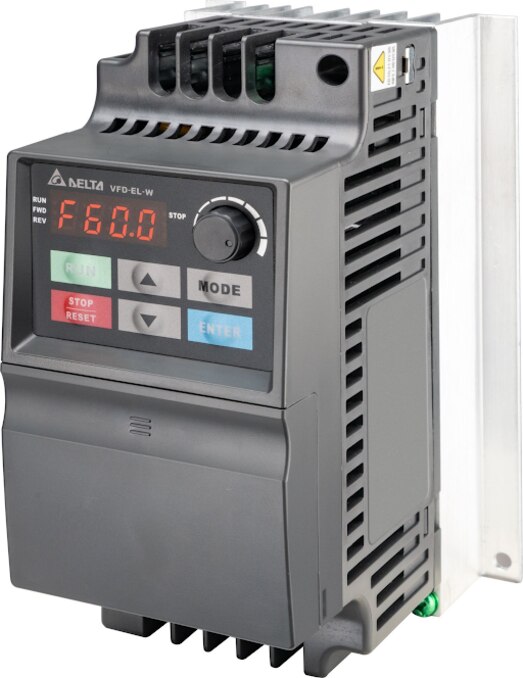
Choosing a Delta VFD starts with the load, not the motor’s horsepower label. By the end, you will be able to match a drive to pump, fan, conveyor and automation duties, check installation compatibility, and identify the controls, protection and commissioning work required before purchase.
Key takeaways
- Match centrifugal pump and fan drives to duty curves, not motor power alone.
- Check motor voltage, full-load current, overload rating and drive capacity before installation.
- Set acceleration, deceleration, speed limits and protection parameters for the machine load.
- Budget for panel hardware, cabling, commissioning, maintenance and energy performance—not just the VFD.
How do you match a Delta VFD to a pump or fan?
Match the Delta VFD to the pump curve or fan duty, not to motor power alone. A centrifugal pump and a fan are variable-torque loads: flow varies roughly with speed, pressure or head with speed squared, and ideal shaft power with speed cubed.
At 80% speed, ideal power is about 51% of full-speed power, but static head, throttling losses, minimum flow and poor motor loading reduce actual savings.
1. Record the required flow, head or static pressure, minimum airflow, duty point and operating range. Set minimum and maximum speed from the curve or duty, then verify minimum pump flow, anti-cycling time, pressure-transducer feedback and protection against dry running, loss of liquid, deadheading, recirculation, overheating and vibration.
For fans, use static-pressure control and replace damper throttling only when minimum airflow, fire-mode requirements and system ventilation rules remain satisfied.
2. Use the Delta CP2000’s PID control, sleep and wake operation, multiple-pump control and pump or fan protection logic for straightforward booster, HVAC or cooling-tower duties. A PLC remains necessary for complex sequencing, interlocks, fire logic or coordinated equipment.
3. Check low-speed cooling before approving the range. A TEFC motor’s shaft fan moves less air at reduced speed; an independent blower, larger motor or manufacturer-approved derating curve may be necessary. Do not assume full nameplate torque at 10–20% speed, and do not let PID alone conceal a closed valve or an empty pump.
What must a Delta VFD handle on conveyors and automated machines?
Conveyors are constant-torque loads: the drive must break static friction, start the loaded belt, and sustain torque at the required speed. Check loaded starting torque, gearbox capacity, belt take-up forces, acceleration time and low-speed regulation before selecting the Delta VFD.
Sensorless vector control is preferable to basic V/f when starting torque or speed regulation matters; confirm how long the drive can deliver its overload current, not just its peak value.
Detect belt slip, jams and speed loss with a pulse sensor, proximity switch, analogue speed signal, motor-current limit or PLC logic. A drive can report output frequency while the belt has stopped.
Ordinary speed control is not positioning or motion control.
| Capability | What must be specified | Consequence |
|---|---|---|
| Speed control | Commanded frequency and ramp | Suitable for general conveyor operation |
| Tension or registration | Encoder feedback, response and stopping accuracy | Requires closed-loop control and application engineering |
| Synchronized axes | Encoder type, network cycle time and safety architecture | Requires compatible feedback and motion coordination |
A high-inertia, declined or back-driven conveyor can regenerate energy into the DC bus during deceleration. Use a longer ramp, or specify a braking resistor and suitable braking transistor, regenerative unit or mechanical brake when the bus voltage rises. A resistor dissipates energy; it cannot hold a suspended or back-driven load.
Use PLC start and stop commands, digital and analogue I/O, PID loops, HMI status and alarms, plus Modbus RTU or Ethernet-based PLC communication. Safe Torque Off removes motor torque, not electrical isolation, controlled stopping or brake holding; combine it with interlocks, a risk-assessed stop and a separately controlled brake where required.
How do you size and electrically match the drive before installation?
Read the motor nameplate before choosing a drive. Record motor full-load current, voltage, frequency, rated speed and power factor, then compare the current with the Delta VFD’s continuous output-current rating. Select normal-duty or heavy-duty overload capacity according to the actual pump, fan, conveyor or machine load, not horsepower alone.
Equal-kW motors can have different currents, service factors and starting demands.
Check these electrical matches before ordering:
- Confirm single-phase or three-phase supply, and match a 230 V motor or 415 V motor compatibility with the drive’s input and output ranges.
- Check whether the motor links require star or delta connection, and confirm 50 Hz operation.
- Allow for voltage drop in the supply and motor cables; verify that the source transformer, feeder and protection can supply the drive.
- Provide panel ventilation, enclosure IP rating, ambient-temperature derating, clearance, fuses or circuit breakers, isolation and protective earthing.
| Duty selection | Required check | Consequence |
|---|---|---|
| Normal duty | Pump or fan current and overload demand | Use only where acceleration and overload remain within the rating |
| Heavy duty | Conveyor, hoist or high-starting-torque load | Select the higher overload rating and suitable overload duration |
| Multiple motors | Same commanded frequency | Give each motor individual overload protection; use separate drives for independent starting or synchronising |
Long cables raise reflected-wave voltage, common-mode current and bearing-current risk. Check the Delta manual and motor insulation limits for cable length, carrier frequency, output reactor, dV/dt filter and bearing protection.
For EMC, use shielded motor cable, short high-frequency bonding paths, separated power and control wiring, and input reactors or DC chokes. Select an inverter-compatible RCD. Never open a contactor between a running drive and motor; stop or inhibit the drive first, and electrically and mechanically interlock any bypass.
How should you commission and compare a Delta VFD system?
VFD commissioning starts with isolation and verification: check supply, motor, earth, control wiring and interlocks against the wiring diagram before energising. Enter the motor nameplate voltage, current, frequency, rated speed and power factor.
- Perform the manufacturer’s autotune with the motor stopped and uncoupled when the motor and application permit it.
- Set acceleration and deceleration times for the load, then confirm minimum and maximum frequency limits.
- Test forward rotation briefly; reverse two motor phases only with the drive isolated if rotation is wrong.
- Run unloaded, then loaded, recording current draw, ramp behaviour and fault-trip response.
- Check pressure or airflow feedback on pumps and fans; test conveyor loaded starts, jams and stopping behaviour.
The comparison depends on the job, not the motor’s kW alone.
| Option | Prefer a Delta VFD when | Choose the alternative when |
|---|---|---|
| Direct-on-line starter | You need reduced starting current, speed control or process feedback | Full-speed operation and high starting current are acceptable |
| Star-delta starter | You need adjustable speed or smoother process control | A fixed-speed motor tolerates reduced star starting torque |
| Soft starter comparison | You need continuous speed adjustment after starting | You need ramped starting only, without speed control |
| Throttling valve or outlet damper | Speed reduction can save energy and improve control | The process must run at one speed |
| Mechanical variable-speed drive | Electronic control, feedback and diagnostics add value | Existing mechanical adjustment is simpler and adequate |
| Fixed-speed operation | — | The duty has no control benefit to justify drive complexity |
Reject the choice for an uncertified hazardous area, starting torque beyond the drive rating, a constant-speed duty, or safety-rated motion requiring a certified motion platform. Perfect Engineering Solutions can confirm the Delta manual, wiring diagram, application macro, communications option, warranty boundary and commissioning responsibility; the engineer still approves the machine design.
Related products
 | Star Delta Starter Panel Phase Single Phase Motor Power 1 HP Voltage 220/240 V Automation Grade Automatic Power Rating (kW) 0.75KW Brand DELTA Material SS Usage/Application... View product → |
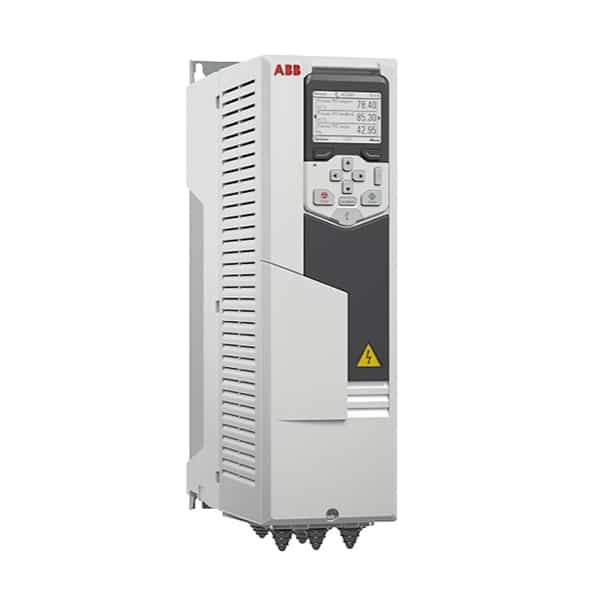 | ABB VFD Drive ACS560 ABB VFD Drive, 3 - Phase, 415V Brand ABB Model Name/Number ACS560 Motor Power 415V Input Voltage 230V Input Phase 3 - Phase ABB VFD for Various Industrial Applications. View product → |
How do you troubleshoot, maintain and budget for the complete system?
Begin VFD troubleshooting with the fault history, not the reset button. Record the alarm, operating speed, load condition and time; a successful restart does not remove the cause.
1. An overcurrent alarm indicates excessive acceleration demand, a jam, short circuit or incorrect motor data. Overvoltage indicates rapid deceleration or regeneration; DC-bus overvoltage on a high-inertia or declined conveyor may require a longer ramp, braking resistor and transistor, regenerative unit or mechanical brake. An undervoltage alarm indicates supply weakness or input interruption.
2. Treat overload as sustained excess current or drive undersizing. Treat an earth fault as insulation or cable damage, motor overtemperature as overload, poor cooling or low-speed operation, and a communication alarm as an addressing, wiring, shielding or network-configuration fault.
3. For preventive maintenance, inspect airflow, dust, cooling fans, filters, heatsinks and terminal torque. Record current and fault trends, inspect cable terminations, verify safety circuits, and keep control wiring separate from power wiring.
4. Disconnect the VFD before testing motor or cable insulation. A megohmmeter connected through the drive can damage its electronics; test the isolated motor and cable instead.
5. Budget the complete system: engineer the control loop, choose bypass or braking hardware, enter parameters, commission, train operators, document parameter backups and keep a spare drive. Include shielded cabling, reactors or DC chokes, suitable RCD protection and electrically interlocked bypass contactors.
Judge the expected energy or process benefit against this engineering, maintenance and downtime effort. The VFD purchase price is not the system’s total cost.
Frequently asked questions
How do you match a Delta VFD to a pump or fan?
Match the drive to the motor’s voltage and full-load current, then confirm the pump curve or fan duty. Centrifugal loads follow variable-torque behaviour: flow varies with speed, pressure or head with speed squared, and ideal shaft power with speed cubed.
What must a Delta VFD handle on conveyors and automated machines?
Check starting torque, acceleration time, stopping method, braking requirements, speed range, load inertia and the machine’s control signals. Conveyors may need higher overload capacity than pumps or fans, especially during loaded starts.
How do you size and electrically match the drive before installation?
Verify the motor nameplate voltage, phase, full-load current, frequency and connection, then compare those values with the Delta VFD ratings. Check supply voltage, short-circuit protection, cable length, grounding, braking hardware and enclosure requirements.
How should you commission and compare a Delta VFD system?
Enter the motor nameplate data, confirm rotation, set safe minimum and maximum frequencies, tune acceleration and deceleration, test under operating load and record alarms. Compare systems by control performance, energy use, installation work, service access and total cost.
How do you troubleshoot, maintain and budget for the complete system?
Start with the alarm code, motor current, supply voltage, wiring, cooling airflow and mechanical load. Include the VFD, panel, isolator, fuses or breaker, reactor or filter when required, cabling, braking components, commissioning and planned maintenance in the budget.
Related products
 | Vfd Drive Enclosure Type IP52 Power 2 HP Usage For Industrial Machinery Brand FUJI Phase 3 Phase Model Name/Number Fuji MInI VFD Motor Power 2 HP Input Voltage... View product → |
 | Inovance VFD Drive Brand Inovance Model Name/Number MD380 Motor Power 230V Input Voltage 400V Input Phase 1 - Phase Display Digital IP Rating IP40 Perfect Engineering... View product → |
 | Motor Pump 0.5HP Havells High Flow Motor, 1500 rpm Type Aluminium Horsepower 0.5 HP Speed 1500 rpm Material Cast Iron Mounting Type Foot Colour Grey Brand Havells Self Priming Regenerative Pumps - 0.5... View product → |
 | Elgi Variable Frequency Drive Voltage 415V Usage For Industrial Machinery Brand INOVANCE Phase 3 Phase Model Name/Number Inovance 20HP Drive Motor Power 20HP Input Voltage 415V... View product → |